Adorers of the
Blood of Christ

Our History

The alarming picture of the post-Napoleonic period could not leave the young Roman priest, Gaspar Del Bufalo (1786-1837), indifferent. In his contemplation of God’s love for humanity expressed in Jesus’ bloody sacrifice, Gaspar understood the priceless value of each human person redeemed by His Precious Blood and sees in the power of this Blood the only anchor of salvation from many evils.  Finding himself a prisoner in Bologna, he plans two Institutes to this end, one a men’s institute and the other a women’s.  Both were to contribute to the reform of society, the first through popular missions and the second through effective Christian and devotional education, working with all their might that this blood not be shed in vain but that each person take advantage of it for his or her salvation.

March 4, 1834

The women's Institute begins in Acuto (FR) in the diocese of Anagni, through the work of Maria De Mattias who opened a school for the girls of the people. Later she gathers young people and married women, gives retreats, animates liturgies, promotes women who will be able to reform their families, the first cell of society. In a short time, other companions join her, and open schools in the small towns of the Pontifical State and the Kingdom of Naples. She wrote, “The purpose of this Institute is the same as that of the Blood of Christ.”

May 30, 1855

His holiness Pius IX grants the “decree of praise” after having learned of the Institute from the testimonial letters of the Bishops in whose dioceses the Adorers zealously dedicated themselves to the Christian and civic education of the poor girls.

January 1857

Printing of the first Rule of the Adorers.

October 17, 1860

The Sisters of Perpetual Adoration of the Precious Blood, founded in Steinerberg (Switzerland) and transferred to Gurtweil (Germany), join the Institute of the Adorers of Acuto, adopting its Rule and habit.

August 20, 1866

Maria De Mattias dies in Rome of tuberculosis at the age of 61. At that time, there were more than 200 Sisters in the Institute. Sixty-four schools had been opened, one of which was in London (1863 -1879).

February 28, 1870

The first group of German-speaking Sisters go to the USA following the kulturkampf in Germany and accept a school for children of German immigrants in Piopolis, Illinois.

January 28, 1878

The Adorers of the Most Precious Blood are recognized as a pontifical Institute.

October 7, 1879

Another group of German Sisters goes to Banjaluka in Bosnia to open orphanages and schools.

April 7, 1897

Pope Leo XII definitively approves the Constitutions.

May 31, 1929

The Congregation is divided into religious provinces.

February 26, 1934

The Congregation of Religious approves the Constitutions revised on the basis of the Code of Canon Law.

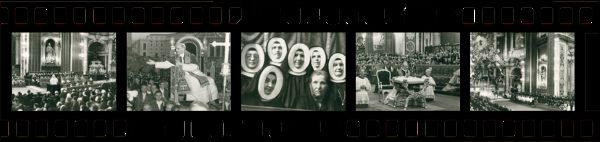
October 1, 1950

Pope Pius XII beatifies Maria De Mattias, the Foundress of the Institute.
March 23, 1964

The Sisters Perpetual Adorers of the Sacred Heart of Jesus in Orvieto (TR) of the St. Paul Institute join the Adorers of the Most Precious Blood on their own accord.

June 14 – August 30, 1968

A special General Chapter was held for the revision of the Constitution required by Vatican Council II. This chapter is prepared by an international commission, which involved all the Sisters of the Congregation. The principles emphasized by the Council in religious life were applied. “Return to our sources” was facilitated by the coinciding of the centennial of the death of the Foundress and discovery of many documents from the beginnings of the Institute in the Anagni diocesan archives.

September 14, 1968

The title of the Institute is changed from Sisters of the Most Precious Blood (Ad.PP.S.) to Sisters Adorers of the Blood of Christ (ASC).

1984

150th anniversary of foundation.

This celebration, preceded by three years of preparation with in-depth study of the themes of adoration-mission, contributes to the development of the charism of the Congregation and the spirituality of the Precious Blood.
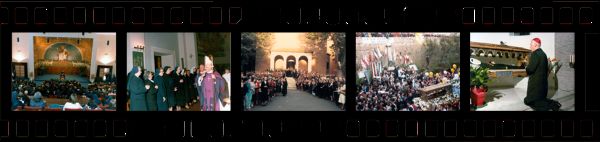
Pentecost 1992

Definitive approval of the Constitution by the Congregation for Religious, after a twelve-year experimentation and an updated revision with the involvement of all the members of the Congregation.

October 1992

Five Adorers of the Blood of Christ from the USA, missionaries in Liberia (Africa), are killed during the civil war. The Pope called them “Martyrs of charity.”

2000

The three American provinces joined in a single United States Region. The headquarters of the US ASC administration is in St. Louis-Missouri.

May 18, 2003

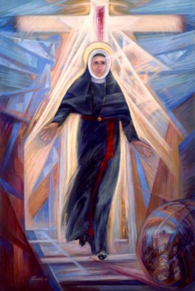
On May 18, 2003, Pope John Paul II proclaimed her a saint and presented her to the entire Church as a model of Christian and consecrated life, describing her as a fervent mystic and a passionate woman of action who, in the fields of education and evangelization, opened new paths for women’s participation in the Church and offered original models of service to the Gospel.
2007

The four Italian provinces also made the same choice by merging into a single Italian Region. The seat of the regional administration is the house of S. Giovanni in Laterano, in Rome.

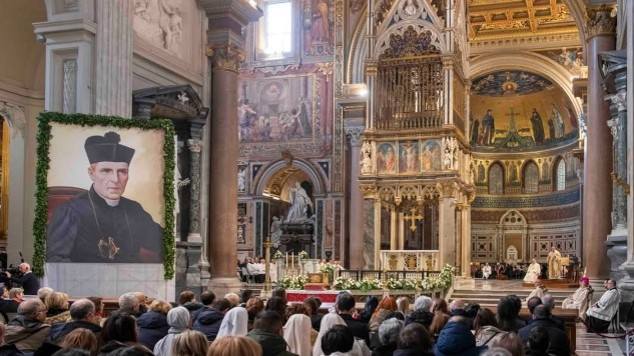
January 12, 2025

Father John Merlini, CPPS, spiritual director of Santa Maria De Mattias, was beatified on January 12, 2025, becoming the first person to be beatified that year.
In May 2024, Pope Francis had approved the decree regarding the miracle that took place in Benevento, attributed to the intercession of the newly beatified.
The miracle involved the healing of a man suffering from a hematoma that caused a buildup of blood behind the abdominal cavity, gradually leading to organ failure. Doctors had discharged him from the hospital, expecting him to die at home.
However, his wife obtained a third-class relic of Father John Merlini; trusting in the power of the intercession of the Missionary of the Most Precious Blood, she decided to place the relic under her husband’s pillow. After just one day in contact with the relic, the man began to show inexplicable signs of improvement, eventually achieving a complete recovery. This event is one of many examples of the work of the Most Precious Blood in the life of the Blessed.